Featured

TWiB Lesson #628 (1 of 8)
When partner opens 1-Major and we play 2/1 GF, then a 1NT response is used with most hands that have minimum or invitational values without a fit, showing 6-11 points. A 2NT response to a Major suit opening is not used as a natural bid because it is Jacoby 2NT, showing game forcing values and at least 4-card support. So the question is what should a jump to 3NT in response to a 1-Major opening show?
TWiB Lesson #629 (2 of 8)
When partner opens the bidding with 1 ♣ or 1 ♦ then our primary objective is to look for a Major suit fit. We do so by responding to 1-Major when we have a 4-card Major suit. We do so if we have 6 HCP or even enough for game (a good 12+ points). If we do not have a 4-card Major suit, but we have a balanced hand with enough values for game, then our most common action is to just bid the game we are likely to make, 3NT!
TWiB Lesson #630 (3 of 8)
The modern expert 2NT response to a 1-Major opening shows a limit raise or better (LR+), instead of game forcing values. This has many different inventors, advocates, and variants. In Europe, it is known as Limit Sternberg while in America, Larry Cohen popularized a similar approach. The idea of using 1M – 2NT as LR+ accomplishes a couple of goals. First, this opens up 1M – 3M to always be…
TWiB Lesson #631 (4 of 8)
When we are a passed hand and partner opens the bidding, we must be careful in trying to describe our hand. Partner’s opening bid in the 3rd seat can be light in values, trying to be destructive or lead-directing, so we cannot respond to it in the same way we would a normal opening bid. Specifically, if partner opens 1-Major in the 3rd seat, we should not go jumping around without…
TWiB Lesson #632 (5 of 8)
In general, we use jumps in competitive auctions as weak bids (0-5 points) applying the Law of Total Tricks (LOTT) -- (though sometimes the modern approach can be to use mixed bids, 6-9 points). The key is that we jump to our Law level, eating up bidding space, to quickly and narrowly define our hand. Let’s look at how we can better describe our hand to partner while preempting the auction.
TWiB Lesson #602 (1 of 8)
There are a variety of conventional rebids that are additions to a fundamental 2/1 GF system, but there are also some fundamental response agreements that can be adjusted. One of these is the length that we promise when we respond in a minor suit at the 2-level. In the standard 2/1 system, a 2♥ response shows at least a 5-card suit, a 2♦ response shows at least a 4-card suit, and 2♣ usually shows a 4+card suit (occasionally it could be a 3-card suit).
TWiB Lesson #603 (2 of 8)
When we choose to adopt the alternative approach to our 2/1 GF responses, 2♦ showing a 5+card suit, 2♣ being “could be short as 2 cards”, then this changes our reasonable options for rebids by the Opener. Good agreements with partner about how this approach changes our rebid agreements are vital. Let’s look at the hands that are simplified & problems created.
TWiB Lesson #604 (3 of 8)
When we play the version of 2/1 GF that uses “2-Major Waiting” (meaning that Opener can rebid their suit without promising a 6th card), then we gain the ability to “right side” a NT contract when we have a balanced hand without a stopper in one of the suits. But, by having 2-Major be a waiting bid we make it harder for us to show our 6-card suit. Let’s see how we can add a gadget to help give us better rebid options to describe our hand.
TWiB Lesson #605 (4 of 8)
The most complicated 2/1 GF auctions are the ones that start 1♦ – 2♣. Actually, these can be some of the most difficult auctions in all of bridge. These auctions can lead to lots of complexity and confusion about the meaning of bids on the second and third round of the bidding. Many pairs have played in 3-3 Major suit fits after the auction began with 1♦ - 2♣, thinking they were headed to a much better fit. Let’s take a look.
TWiB Lesson #594 (1 of 9)
There are two general categories of systems against the opponents 1NT opening bids – ones that use a Double as Penalty and others that use a Double as conventional. When the opponents open the bidding with a weak 1NT we need a good method for dealing with their unusual opening bid. The most common range for a weak NT is 12-14 points, but we define 1NT to be weak if the range does not contain 16 points. Some examples: 10-12, 11-13, 11-14, 12-14, 12-15, or 13-15 points. Against these opening bids we use a system that has a penalty double. Let’s look at one of the most interesting of these systems, Landy with Transfer bids.
TWiB Lesson #595 (2 of 9)
Transfers have become a larger and larger part of both competitive and constructive bidding. They help with playing the contract from correct side, but they are also effective in searching for a fit while keeping the auction at a low level. One auction where transfers by Responder can be helpful is after Opener has started with a suit opening bid at the 1-level (1X) and then made a jump rebid of 2NT – showing a balanced hand with 18-19 points. See how transfers by Responder in this auction can help our side describe our hands in the limited space below 3NT. This replaces Modified Wolff Signoff after a 2NT rebid.
TWiB Lesson #596 (3 of 9)
Responding to 1NT is a balancing act of showing both strength and shape while keeping the auction at a low enough level. With a game forcing hand (10+ points), the goal is usually to be able to describe our hand below 3NT, particularly with hands that are strong enough to be interested in slam. This is not a problem with relatively balanced hands, but with distributional hands it may be more difficult for Responder to show their shape and explore slam without getting the auction too high (going past 3NT). After a transfer bid, Responder often gets a second bid without raising the auction much — one of the key benefits of transfers.
TWiB Lesson #597 (4 of 9)
The modern approach to improving our bidding structures (especially in competition) is to add transfers to our methods. This gives us more space and allows us to communicate more efficiently. When we play a system like McCabe, designed to give us more ways of raising partner and show support, we already have a useful structure. If we add transfers to this structure, we gain even more space for communication, making it easier to describe hand strength, clarify fits, and reach better contracts more consistently at the table, even under pressure, against tough opponents in competitive auctions.
TWiB Lesson #598 (5 of 9)
When partner opens the bidding with a Major suit and right-hand opponent makes a takeout double, the modern approach for many expert partnerships is to play transfer bids by Responder. When Responder transfers to the suit with length instead of bidding it, we gain many advantages in these competitive bidding auctions. Let’s look at how we use these transfers by Responder and what they gain for us — improving both clarity and flexibility in our partnership communication, and helping us find the best fit even when opponents interfere. We’ll also see how these methods can simplify auctions and lead to more accurate, confident contracts.
TWiB Lesson #599 (6 of 9)
When partner opens the bidding with a minor suit and right-hand opponent makes a takeout double, the modern approach for many expert partnerships is to play transfer bids by the Responder. By Responder transferring to the suit with length instead of bidding it directly, we gain many advantages in these competitive bidding auctions. These transfers help clarify hand strength, improve accuracy in finding major-suit fits, and allow the partnership to describe shape efficiently while keeping bidding space available. Let’s look at how we use these transfers by Responder and what they gain for us.
TWiB Lesson #600 (7 of 9)
When partner opens the bidding with 1-minor and our RHO makes an overcall of a suit, then we need a way to describe our hand to partner. The traditional Responder tools are negative doubles and positive freebids, but in some auctions, other approaches that use transfers give us a better and more flexible way to compete as Responder. Unfortunately, we don’t have a transfer structure in every auction (when they overcall 1♠, we have very few good systems available), but hopefully there will be more and more interesting developments in this fascinating area of bidding theory.
TWiB Lesson #601 (8 of 9)
Transfers are an extremely useful tool for competitive bidding. So are relay bids, like the way we use 2NT in a Lebensohl auction. We can play a useful system, like Transfer Lebensohl, in a variety of situations. Let’s see how we can use these methods after partner opens the bidding and the opponents take away our bidding space with a Weak Jump Overcall, giving us structured ways to compete without guessing while keeping partner fully informed. These agreements help us navigate tough auctions with clarity.
TWiB Lesson #606 (9 of 9)
The modern approach to improving our bidding structures (especially in competition) is to add transfers to our methods. This gives us more space and allows us to communicate more efficiently. When we play a system like McCabe, designed to give us more ways of raising partner and show support, we already have a useful structure. If we add transfers to this structure, we gain even more space for communication, making it easier to describe hand strength, clarify fits, and reach better contracts more consistently at the table, even under pressure, against tough opponents in competitive auctions.
TWiB Lesson #585 (1 of 9)
The concept of having a conventional bid like Drury available to show a limit raise in support of partner’s Major suit when we are a passed hand is a regular part of most partnerships’ passed hand bidding structure. Given that making a 2/1 bid into a minor suit is not that attractive (or even possible!) by a passed hand, it makes sense to allocate both 2♣ and 2♦ as artificial raises of Opener’s third seat (or fourth seat) Major suit opening bid. Many partnerships that play Drury play 2-Way Drury, using one bid to show a 3-card limit raise and the other a 4-card limit raise. But a more sophisticated structure can allow us to describe even more hand types in the same bidding space.
TWiB Lesson #586 (2 of 9)
New Minor Forcing is an excellent convention for continuing the auction when Opener has shown a balanced hand that is weaker than opening 1NT. But after a New Minor Forcing bid, the auction often gets complicated if we don’t go straight to game. It can be confusing whether we are inviting game or trying to make a slam try – which bids are forcing and which bids are non-forcing? 2-Way New Minor Forcing is an upgrade to New Minor Forcing that allows Responder to better describe their hand and simplify and clarify the rest of the auction. Let’s take look at how this works to make your bidding smoother and more precise.
TWiB Lesson #587 (3 of 9)
When the auction begins 1X – 1Y – 1NT (where X and Y are different suit bids), the modern treatment is to play Two-Way New Minor Forcing. This approach uses both 2♣ and 2♦ as artificial and forcing bids by Responder. 2♦ is an artificial game forcing bid, while 2♣ is generally used to start invitational bidding sequences. XYZ is a convention that is an extension of this approach in other auctions that start with three bids at the 1-level. By learning these tools, players gain greater flexibility, clearer communication, improved accuracy, stronger control of the auction, and better partnership understanding. Let’s look at the details of how this can improve our bidding.
TWiB Lesson #588 (4 of 9)
When we find a Major suit fit and are interested in game (1M – 2M), we need a good way to explore or invite game. The traditional method is the Help Suit Game Try (HSGT), where Opener asks for help in a side suit. We also have 2NT as a general game try (some use it as a trump suit try) and a raise to 3-Major as 1-2-3 Stop or a quantitative try. This structure works but has two main problems: 1) both players must guess about wasted values opposite shortness, and 2) Declarer’s side-suit description helps the opponents defend. Kokish Game Tries upgrade HSGT, giving up very little while solving these issues. Let’s see how they work in real auctions and practical play.
TWiB Lesson #589 (5 of 9)
When partner opens the bidding in a suit at the 1-level and the next player overcalls 1NT, we want to have a system that allows us to deal with this interference effectively. With a good hand (which is somewhat rare in this auction), we make a penalty double. With a poor hand that is relatively balanced, we likely want to stay out of the auction and simply pass. It is the distributional hands with some values, but less than 10 HCP, where we are likely to want to compete in the bidding. One way to make bidding these distributional hands easier is to use a system like the one we use over a 1NT opening.
TWiB Lesson #590 (6 of 9)
Another approach for using 2♥ and 2♠ responses to 1-minor suit opening bids is to use these bids to show a variety of problematic hands that have length in both Major suits. This method, called Reverse Flannery, is particularly effective after a 1♦ opening bid. It originally comes from Precision, where 1♦ is the only “natural” 1-minor opening bid. By using Reverse Flannery, partnerships gain a clearer, more precise way to describe hands, reduce misunderstandings, and improve their chances of reaching the best contract. Let’s look at how this works and see what types of hands these agreements can help us bid better.
TWiB Lesson #591 (7 of 9)
When we use Inverted Minors to raise partner’s suit, the traditional approach is to show Major suit stoppers and determine whether we can play a notrump contract. A more sophisticated approach is to use an artificial structure that allows Opener to show their hand type and strength and allow Responder to determine where to play the final contract (and who should be the declarer in notrump). This framework provides flexibility and often uncovers better game or slam contracts that standard methods might overlook. A similar approach to this structure can be used in 1♦ – 2♣ auctions as well.
TWiB Lesson #592 (8 of 9)
When partner opens the bidding 1-minor (1m), a jump shift to 2-Major (2M) by Responder can be used for a variety of different hand types. Both the standard approach of a strong jump shift and the common approach of a weak jump shift leave a lot to be desired. The modern style is for good hands to go slow, which makes a strong jump shift less appealing because it eats up valuable bidding space. With players responding to a 1m opening bid with 1M more and more aggressively, this makes using a weak jump shift less common…
TWiB Lesson #593 (9 of 9)
When our side opens the bidding 2♣, we need an agreement about how we handle our responses. There are a variety of ways to handle this -- 2♦ waiting, Steps, Controls, 2♥ Bust. People have strong opinions about 2♥ for showing a bust. The players who dislike it are worried about “wrong siding” a ♥ contract. The players who like it like knowing that 2♦ is game forcing, determining if we are going to game or not immediately. I personally like the idea of setting up the GF immediately, making the auctions after a 2♦ response less ambiguous. When I have a “positive response”, I basically always bid 2♦ and leave…
TWiB Lesson #576 (1 of 9)
Balanced hand bidding is relatively easy. We can usually describe our hand to partner by opening 1NT or rebidding 1NT. This lets partner know both our points and our hand type with either our first bid (when we open 1NT, the best situation) or with our second bid (when we rebid 1NT). However, if we have a big balanced hand then we need to have tools for describing our hand as well. These usually involve the use of 2NT – as a rebid, an opening bid, or even a rebid after having opened the bidding 2♣. But this does not solve all our bidding problems.
TWiB Lesson #577 (2 of 9)
When Opener makes a jump shift into a new suit with their second bid, it is a strong bid that creates a game forcing auction. This is a good bid because it ensures we reach game, but it is a bad bid because it eats up a lot of bidding space without fully describing our distribution. This is a problem. One of the most difficult opening hands to describe to partner is the unbalanced single-suited (one 6+card suit) hand with 18-19 HCP. This is one of the strongest hands that does not open the bidding 2♣. Let’s look at a system that helps us improve our jump shift methods.
TWiB Lesson #578 (3 of 9)
When partner opens the bidding with a 2-level or 3-level preemptive opening bid then Responder may have a struggle to find the best final contract without getting the auction too high. One of the natural pressures is whether Responder risk going past 3NT to look for a fit or a better fit. Given the variability of modern preempts it can be dangerous to reach the 5-level when partner has taken an aggressive action. Here we look at a tool, called Preempt Keycard, for Responder to ask for Keycards after a preempt, but still keep the auction at a low level.
TWiB Lesson #579 (4 of 9)
Jacoby 2NT is a useful convention, but many players choose to try to improve it. The modern expert 2NT response to a 1M opening showing a limit raise or better (LR+), instead of game forcing, has many different inventors and advocates. The idea of using 1M – 2NT as LR+ accomplishes a couple of goals: 1) It opens up 1M – 3M to always be a weak call (a valuable tool for making life difficult on the opponents). 2) 1M – 2NT as LR+ approach gives away less information about the Opener’s (soon to be declarer’s) hand than Jacoby 2NT. Let’s see how this works.
TWiB Lesson #580 (5 of 9)
When we move from playing Blackwood to Keycard Blackwood, we improve our slam bidding by including a discussion of the trump King and Queen. Playing Keycards (let’s say 1430), then partner’s answer to our 4NT ask sometimes tells us if they hold the trump Queen and other times does not. In the latter case we need to be able to ask partner if they hold the trump Queen, as we do not want to bid a slam missing a Keycard and the trump Queen. Let’s look at how we ask partner about the trump Queen in a variety of different auctions.
TWiB Lesson #581 (6 of 9)
Most partnerships start with the agreement that they answer this question by showing their number of Kings. But sometimes, a Grand Slam is not about partner having 2 or 3 Kings, but about them having the right single King. This “right King” is often the one opposite our long suit – allowing us to produce a large number of tricks. To get this information, many partnerships evolved their Kingshowing methods from “number of Kings” to “Specific Kings.” Here we look at how we can use Specific Kings in a variety of our Ace-asking auctions.
TWiB Lesson #582 (7 of 9)
We attempt to determine how many of the 5 Keycards we have, plus we also hope to be able to determine if we have the Queen of the trump suit. When ♠ is the trump suit, then we have plenty of bidding space to communicate, but when lower-ranking suits are the trump suit, using 4NT to ask for Keycards leaves us little room to exchange information without getting the auction too high. To fix this problem, some partnerships use Minorwood for their minor suit Keycard auctions, but this does not solve our problem in the ♥ suit. There is another approach, called Kickback, that tries to solve this problem. Let’s see how this works.
TWiB Lesson #583 (8 of 9)
Kickback is a convention that can make slam bidding easier, in that it gives us more space to ask partner for the Queen of trump, but it can also cause problems for us in the bidding. Any time we make a game contract (like 4♥ or 4♠) a conventional bid, there is danger that we have an expensive mixup with partner. Here we look at some classic danger auctions that may come up if we choose to play Kickback and then discuss some of the common partnership agreements or philosophies for how to handle these dangerous auctions. Let’s see how we can put what we've learned into practice and navigate these tricky situations with a clear understanding of likely pitfalls.
TWiB Lesson #584 (9 of 9)
One way that we find out about the location of partner’s Aces is by using control showing bids. This is especially effective if we use them to show first round control (if we play that our control showing bids could be 1st or 2nd round, then we know less about which Aces partner hold). There is a gadget that we can use in some auctions that allows us to try to solve this problem. This convention, called Exclusion Keycard, asks partner for their number of Keycards (or Aces if we play Blackwood), excluding one particular Ace – the place where we are void. This Exclusion allows us to find out if partner has enough of the “right Aces” for us to make slam.
TWiB Lesson #567 (1 of 9)
Most partnerships who play Support Doubles have had a conversation about when they apply and when they do not. Hopefully, we will have a conversation with partner about the follow-up bids as well. But one thing that many partnerships forget to discuss is how high support doubles apply and what a double at a higher level shows. Let’s look at support double auctions in detail to make sure we are on the same page with partner.
TWiB Lesson #568 (2 of 9)
Bridge players keep finding more and more ways to use doubles, especially in low-level competitive auctions. But when Left Hand Opponent (LHO) opens the bidding with a suit, partner overcalls a second suit, and Responder bids a third suit, then a double by Advancer is not a responsive double. It is a different kind of competitive double called a Snapdragon Double – a fancy name for another double that wants to compete in the bidding.
TWiB Lesson #569 (3 of 9)
Traditionally, a redouble in a competitive auction shows a strong hand (10+ points), but with everyone bidding it is not likely that Advancer is too focused on showing values. Instead, we want to design our agreements to let us best describe the most common kinds of hands. Here, we will see how using redouble as a conventional bid, called a Rosenkrantz Redouble, can be more effective than this traditional value-showing redouble.
TWiB Lesson #570 (4 of 9)
The modern game continues to create interesting auctions and we need to make sure to discuss how to respond to new situations with partner. Some of the most interesting (and useful) competitive bids are when we use a suit that the opponents have bid – called a Cuebid. There can be many different meanings for bidding the opponent’s suit. Let’s take a look at cuebids of the opponent’s suit in a variety of different auctions and make sure we are on the same page with partner about the meaning of these calls.
TWiB Lesson #571 (5 of 9)
When the auction begins 1m – 1NT (both bids by the opponents), it’s rare to compete in a minor suit. Usually opponents have the minors, since Responder has denied a 4-card Major. In these auctions, it is effective to play a system geared towards the Major suits where we are most likely to have a fit. Spear is an artificial system that uses all the bids at the 2-level to show different Major suit hands. This gives more options for competing in the bidding. Let’s see how it works.
TWiB Lesson #572 (6 of 9)
When responding to partner’s 1-Major opening bid, Responder tries to apply the Law of Total Tricks (LOTT) – getting to the size of the partnership’s fit as quickly as possible. This LOTT bidding is especially effective when our side has a 9+card fit. Bergen Raises are a set of conventional bids Responder can use when responding to a 1-Major opening bid with 4+card support (at least a 9+card fit). Let’s see how this system works.
TWiB Lesson #573 (7 of 9)
One of my favorite sayings is “2NT is a convention, not a contract.” In specific situations, Responder can use 2NT as conventional raise of Opener’s suit. Sometimes we need to choose between several different conventional methods for competitive auctions. Here we look at our options for how to best use 2NT. If you like conventional raises of partner's suit, then make sure you discuss these auctions with partner.
TWiB Lesson #574 (8 of 9)
Jumping in the auction eats up a lot of bidding space, which is likely to make communicating with partner more difficult. Since our jump bid may make future communication more difficult, it should have a specific meaning. When partner opens the bidding, Responder’s jump shifts can be used to show a variety of different types of hands. We need to decide, as a partnership, which ones we want to use. We will choose different agreements for different situations.
TWiB Lesson #575 (9 of 9)
When partner makes a bid, and we choose to bid a suit of our own, this is called a freebid. In most normal situations freebids show values (called positive freebids) and are often forcing 1-round. We’ve all heard the saying -- a new suit is forcing by an unpassed hand. Unfortunately, this is not always true, but it is often our agreement. Let’s look at freebids made by a passed hand and see how the fact that we are passed changes these situations.
TWiB Lesson #563 (1 of 4)
The Ace is the most powerful card in each suit. It almost always wins a trick (especially in a notrump contract), but the Ace does much more than simply win one trick. The Ace controls the suit. When we hold the Ace of a suit, we get to not only win a trick in that suit, we get to decide when we take our trick and gain the lead. Holding the Ace gives us the power to choose how the play is going to go.
TWiB Lesson #564 (2 of 4)
We usually win tricks with little cards (other than in the trump suit) by setting up our long suits. To establish these little cards in our long suits into winners, we need to play the hand well. This requires using our large cards in the best way possible to establish our little cards. That means we need to play our combinations as best as we can, manage our transportation, and have some good luck in the way the cards divide.
TWiB Lesson #565 (3 of 4)
It is essential to stop the Declarer's attempts to take tricks with small cards in order to properly defend the contract. That means that suits that have potential winners, threat cards, must not be allowed to grow into winners. We attempt to prevent this by covering an honor with an honor (to prevent promotion) and by holding onto our cards in the opponent’s long suits – called guarding the suit.
TWiB Lesson #566 (4 of 4)
Active opening leads attempt to "go out and get" our tricks. Passive leads, on the other hand, attempt to just not give anything away or help Declarer. There are many different types of passive leads for many different situations. Here we take a look at several lead types and hands where a passive lead may or may not have the intended effect!
TWiB Lesson #558 (1 of 9)
By defining our 1NT opening bid to show 14-16 points with a balanced hand, we maintain the general strength of the opening bid while allowing ourselves to open the bidding with it more often. We discuss how you bid if you agree to play this, both as an Opener and as Responder.
TWiB Lesson #559 (2 of 9)
When LHO opens the bidding and the auction passes around to us, we are the last line of defense against the opponents buying the contract at a low level - balancing. When we balance we “borrow” some of partner’s values and add those points to our hand - usually about 3 points.
TWiB Lesson #560 (3 of 9)
A balancing 1NT bid can be a wide-ranging action, about 11-15/16 points. This 5-point range is much larger than most Notrump bids and leaves partner with a more difficult bidding situation. Range Stayman is a tool that can help Advancer better determine the values of our hand and if game is a possibility.
TWiB Lesson #561 (4 of 9)
One place that we do not need a jump bid to show a weak hand is in the balancing seat. In this seat with a weak hand, say 5-8 HCP, and a long suit, we would not bid; we would simply pass the hand out. Theses bids are used to describe different, stronger hands.
TWiB Lesson #562 (5 of 9)
When our left-hand opponent opens the bidding and the auction passes around to us, we have a big decision to make – should we get into this auction, or should we leave the opponents to play at the 1-level? We have a variety of bidding tools to help us compete in the bidding.
TWiB Lesson #550 (1 of 8)
When RHO opens a 2-level preempt, they have started eating up our valuable bidding space. But this is just the start of their attack on us. LHO may join in the attack and raise the preempt, making our life even more difficult. When we are bidding over RHO’s 2-level preempt we should keep this in mind. We need lots of tools to deal with this situation.
TWiB Lesson #551 (2 of 8)
When the opponents open at the 4-level they put a lot of pressure on us to make difficult decisions without much room to maneuver or describe our hand. This preempt will force us to either double or overcall at a very high level. Let’s look at these options and see how we need to adjust our thinking and bidding because of the lack of available space.
TWiB Lesson #552 (3 of 8)
When the opponents open the bidding with a 3-level preempt then much of tour focus is on “Should we bid beyond 3NT?” This is especially true when we have one long minor, when we likely want to play in 3NT or 5-minor. This allows us to use 4-minor in some interesting conventional ways, just as we do vs. a 2-level preempt.
TWiB Lesson #553 (4 of 8)
When the opponents stay out of our auctions then usually 4NT is Quantitative in a NT auction or Keycard in a suit auction. But in a competitive auction we are more likely to use 4NT as a bid showing 2 places to play. Let’s look at some of these auctions so we know what partner is trying to do to when they use 4NT in a competitive auction.
TWiB Lesson #554 (5 of 8)
Good/Bad 2NT gives Opener two ways to compete to the 3-level – by bidding directly with a “Good Hand” or by bidding 2NT first with a “Bad Hand”. By using 2NT as a relay bid, instead of a natural call, this allows for a more precise description of Opener’s hand. Let’s see how it works through examples.
TWiB Lesson #555 (6 of 8)
In competitive auctions where the opponents have found a fit, we will compete aggressively – especially at matchpoints. We will frequently use double (for takeout) with three-suited hands and sometimes with two-suited hands. To handle these situations, we want partner (Advancer) to have a tool to help us find our best fit. As usual, in competitive auctions our choice of convention will be 2NT.
TWiB Lesson #556 (7 of 8)
Lead-directing doubles can be helpful in getting partner off to a good opening lead. These lead-directing doubles are common when the opponents make an artificial bid. But when the opponents make a cuebid of our suit, then a lead-directing double is also very common. Here we focus on this situation in detail in order to structure our agreements to allow us to communicate in the most effective way we can.
TWiB Lesson #557 (8 of 8)
There are certain auctions where we have made a bid that has “fully described our hand” and we leave the bidding up to partner. In this case we can use a Double as a conventional bid saying “I want to bid more”. This is called an I Want to bid Double and it applies in very specific situations to open the bidding with it more often. Let’s take a look at these in more detail.
TWiB Lesson #541 (1 of 9)
When the opponents open the bidding with a strong 1NT the hand usually belongs to them, as we are less likely to have a majority of the HCP. We usually compete with shapely hands - 1-suited or 2-suited distributional hands.
TWiB Lesson #542 (2 of 9)
There are many artificial systems for competing over the opponent’s 1NT opening bid. Woolsey is focused on finding Major suit fits while allowing us to compete as cheaply as possible.
TWiB Lesson #543 (3 of 9)
When the opponents are playing a “Weak 1NT” opening bid (for example, 12-14 points), we need to bid only when we have a decently valued hand. It is common to use a different bidding system against the opponents’ Weak 1NT opening bid than the one you use against a strong 1NT opening.
TWiB Lesson #544 (4 of 9)
When constructing a system to allow us to bid over these weak 1NT openings we need to take a different approach than bidding over a strong 1NT opening. Thus, we construct our bidding system to allow us to explore game and make constructive bids, not just be destructive.
TWiB Lesson #545 (5 of 9)
After partner opens 1NT, we have a good structure for using our bids efficiently to describe our hand to partner. But when the opponents interfere in our auction, we lose some of this valuable bidding space and need to change our approach in order to deal with their interference.
TWiB Lesson #546 (6 of 9)
There are many systems the opponents play in order to interfere over our 1NT opening bid, but almost all of these systems use the 3-level (actually 2NT+) for the same meanings – 2NT as a weak bid showing both minors and 3-level bids as weak with a long suit, preemptive. It is important that you and partner are on the same page for how to deal with this higher-level interference.
TWiB Lesson #547 (7 of 9)
When we open the bidding with 1NT if an opponent makes a penalty double, we are less likely to be we are usually looking to escape from a 1NT contract and attempt to find some safer place to play. This safe place will hopefully be our largest fit or a long suit in the weak hand (in Responder’s hand). In order to find this place to play we need to look at how Responder’s bidding options change after a penalty double.
TWiB Lesson #548 (8 of 9)
Lebensohl is an excellent system for dealing with interference over our 1NT opening bids. But Lebensohl has some flaws. In Lebensohl auctions we will often play the hand from the “wrong” side (Responder’s side.) Another flaw in Lebensohl relates to Responder’s strength. Responder often has three strengths (buckets) let’s see how Transfer Lebensohl is an upgrade to this.
TWiB Lesson #549 (9 of 9)
One of the most common gadgets that we use when partner opens 1NT is Stayman. We primarily use Stayman to search for a 4-4 Major suit fit. After Stayman sometimes we want to have a way to raise partner’s suit where they cannot pass. We will want a “Forcing Raise” (similar to Jacoby 2NT or Inverted Minors) in order to find out more about Opener’s hand.
TWiB Lesson #532 (1 of 9)
When we are in a game forcing auction and the opponents interfere (usually to sacrifice) it is clear that we are not going to go quietly and just let them steal the contract. If the opponents bid over us, then we will either double them and defend or bid on to our game. Forcing Pass is an agreement used to help us work together with partner to make a good decision about which to do.
TWiB Lesson #533 (2 of 9)
Minor suit slams are much harder to bid than Major suit slams. This is especially true after we open the bidding with 1NT (or 2NT). We start off the auction looking for Major suit fits and only then look for our minor suit fits after that. These Major suit showing bids are the cheapest bids and that means that our minor suit showing bids take up more space. We look at how we overcome this.
TWiB Lesson #534 (3 of 9)
In the Major suits, we try to bid to game at 4-Major or slam at 6-Major. We try not to play in 5-Major, but it does happen, like when the opponents compete and push us beyond game, or when we go looking for slam and determine that we need to stop because we are missing two Aces. So, we can use a 5-Major bid for something other than to end the auction.
TWiB Lesson #535 (4 of 9)
We most frequently use 5NT in Ace-asking auctions to ask for Kings. We now have another use of a 5NT bid in Grand Slam Force. But trying for a grand slam is a rare occurrence and we would like to use 5NT (specially a jump to 5NT) for another more frequently useful purpose. The modern approach is to play a jump to 5NT as a “choice of slams” to help find the best small slam.
TWiB Lesson #536 (5 of 9)
On some highly distributional hands when we ask for Keycards (or Aces) using 4NT, the opponents choose to bid over our 4NT bid to obstruct communication & “get in the way”. We should be prepared for this interference & have agreements for how to communicate with partner (show our number of Keycards or Aces) in this situation.
TWiB Lesson #537 (6 of 9)
When partner bids 4NT as Keycard in our established fit, a void in a side suit can be useful. We may still be able to make a slam if we are missing two Aces/Keycards if the void is in a suit of one of those missing side Aces. We need a way to tell partner about this void if we haven’t already done so earlier in the auction. Let’s see how this play works and how you can utilize this.
TWiB Lesson #538 (7 of 9)
When we have a minor suit fit, using 4-minor as Keycard in our suit (Minorwood) is an effective tool for exploring slam without getting the auction beyond game, beyond 5-minor. But we give up the natural slam try of 4-minor, asking partner to do something forward going for slam, usually starting to make a control showing bid, if they like their hand. Let’s take a look.
TWiB Lesson #539 (8 of 9)
When we find a Major suit fit at the 3-level in a game forcing auction, then partner is usually expressing interest in slam (because without slam interest, partner would have applied the Principle of Fast Arrival and bid 4M.) In this case, now we usually express whether we have slam interest or not by either making a cuebid or simply bidding game with 4M. Let’s see how this all works.
TWiB Lesson #540 (9 of 9)
One of the ways that we investigate slam in a suit contract is the use of control showing bids. When one member of the partnership is interested in slam then they show this interest by making a control showing bid. Once we start the process of making control showing bids then we continue to do so to explore slam. But as the auction approaches game we have a big decision to make.
TWiB Lesson #524 (1 of 8)
One of the most important parts of bridge is raising partner. We try to raise Opener whenever possible. We may choose not to support partner immediately if we feel we have something more pressing to communicate, but in general we strive to “support with support.”
TWiB Lesson #525 (2 of 8)
When partner opens in 3rd or 4th seat and we have a good hand, we do not want to go jumping around to show it – partner may have no game interest for their opening bid. We want to have an effective way of describing our good hands cheaply when partner opens in 3rd or 4th seat.
TWiB Lesson #526 (3 of 8)
We look at ways that Advancer can raise partner's overcalls. It is good to have tools that show a fti and describe your hand -- one of the most common actions we like to take.
TWiB Lesson #527 (4 of 8)
When partner makes a 1-level overcall it is a very wide-ranging action in terms of strength and shape – about 7 to 18 HCP and a 5+card suit. Advancer generally assumes Overcaller has at least 10 HCP, we look at Advancer’s options for bidding and what partner should expect.
TWiB Lesson #528 (5 of 8)
A Mixed Raise shows 4-card support and 7-9 HCP in a competitive auction. Let's see how to implement this very useful bid in even more bidding situations.
TWiB Lesson #529 (6 of 8)
When the auction begins 1X – 1Y – 2Y, we usually have 4-card support for our raise of partner’s suit. But in some auctions, we don’t have a convenient rebid and we are forced to raise on only 3-card support. Here we look at when to raise responder's suit on 3-card support. And then what we do after that -- the trump asking bid, sometimes called Spiral.
TWiB Lesson #530 (7 of 8)
When partner opens the bidding with 1-Major and Responder makes a Splinter bid then this shows our fit, values, and shortness all in one call. This gives an excellent description of our hand and allows partner to re-evaluate their hand based on their working values.. Here we look at the use of Over-Splinters and see how we can use them to give partner additional information about our hand.
TWiB Lesson #531 (8 of 8)
When partner preempts the bidding at the 2-Level, and we have a good hand we expect the auction to be difficult. We need to have good agreements with partner and exercise some good judgment to get to the right final contract. When we have a fit for partner’s suit (especially a Major suit) then we know what strain we are likely to play in. We need to exchange useful information with partner.
TWiB Lesson #515 (1 of 9)
When we open the bidding with 2NT then if we find a major suit fit ( 4-4, 5-3, or 6-2), we get to declarer this from the hand that opens 2NT — the strong side. That makes it opening 2NT something we should strive to do. The modern style is to stretch to open 2NT, even with many good 19 HCP hands.
TWiB Lesson #516 (2 of 9)
When partner opens the bidding 2NT then we have far less space to investigate for a major suit fit. It is important that we make good use of our limited space below 3NT in order to determine if we have a Major suit fit.
TWiB Lesson #517 (3 of 9)
Bidding slam is extremely difficult after partner opens the bidding 2NT — much of our valuable bidding space had been taken away. This is especially true when it comes to finding minor suit slams. But we do have some gadgets that are designed to help us do this.
TWiB Lesson #518 (4 of 9)
When we open the bidding with NT one of partners favorite bidding tools is the Jacoby Transfer. When partner transfers to a major suit and we have an excellent fit we have to decide about super-accepting. Here we look at our options for what to do and how to use our judgment about doing so.
TWiB Lesson #519 (5 of 9)
Gambling 3NT is a powerful preemptive opening bid that can cause the opponents a lot of difficulty as well as describe our hand to partner in a highly precise way. It is also one way we can show a hand that can take a lot of tricks with a solid suit.
TWiB Lesson #520 (6 of 9)
When we open a NT and partner uses an artificial conventional responses, like Stayman or Transfers, then the opponents might double as lead directing. We want to use this double against them. Here we discuss our options for bidding after this double.
TWiB Lesson #521 (7 of 9)
We can use a Stayman response, followed by a 2S rebid to show an invitational hand with length in the majors. But this bidding sequence can be useful with other invitational hands as well. Let’s see how else it can be used.
TWiB Lesson #522 (8 of 9)
When we respond to partner's 1NT opening it is nice to have transfer bids available. Here we look at an upgrade to 4-suited Transfers, called Size Ask, and see how it improves our bidding.
TWiB Lesson #523 (9 of 9)
Here we look at a 3C response to 1NT used as 5-card Stayman. I nice modern addition to your bidding system. This in combination with a 2C Stayman response created an effective system for communication.
TWiB Lesson #506 (1 of 9)
There are certain strengths and shapes that are difficult to describe as opening bids. In order to have a chance of showing this problem hands we have to start the auction off best. Here we look at some of these problem opening bids.
TWiB Lesson #507 (2 of 9)
When we open the bidding in the 3rd seat we have lots of options for how to attack the opponents. Here we look at how we can make the opponents life more difficult and make the best opening bid for our side.
TWiB Lesson #508 (3 of 9)
If you auction goes 3 passes around to you then you have a choice to open the bidding or pass the hand out. If you choose to open the bidding, you have some different bidding tools in the 4th seat. Here we look at our options and how to help us make this decision.
TWiB Lesson #509 (4 of 9)
When we are at favorable vulnerability we have a lot of different options for how to get into the auction. When we are in the 3rd seat, this is even more true. Here we look at how we can use this situation to give us a license to attack.
TWiB Lesson #510 (5 of 9)
We start out the auction seeing if we have a major suit fit. But after that, we try to get to 3NT. When the opponents bid in our auction we have a good idea of what they are going to lead. We can use the Western Cuebid to help find out if we can get to NT. Let’s see how it works!
TWiB Lesson #511 (6 of 9)
When we respond to opener’s bid we have a priority of finding major suit fits. Opener also have a priority of showing their hand type if they do not find a major suit fit. The Walsh style of bidding and rebids are an important improvement in modern bidding.
TWiB Lesson #512 (7 of 9)
Jump Shifts by Responder have a variety of different meanings in different situations. Their means can change based on the level they are made at and if they are in competition. Make sure you have good agreements with your partner about the meaning of these jump shifts.
TWiB Lesson #513 (8 of 9)
When we open the bidding partner often responds with 1NT. It is important for us to have good agreements about common auctions. Here we look at auctions that start with a minor and hear partner respond 1NT. We look at what to expect and how the auction might continue.
TWiB Lesson #514 (9 of 9)
When partner jumps to 2NT after our 1-minor opening we don’t have a lot of space to communicate below 3NT. It is important to have good agreements about the follow-up bidding.
TWiB Lesson #498 (1 of 8)
Here we look at defensive situations in the middle of the hand - we start with a look at covering the opponent's honors -- which one to cover?
TWiB Lesson #499 (2 of 8)
When you can ruff one of Declarer’s tricks it is extremely satisfying. Here we work on techniques that will allow us to do so as often as possible!
TWiB Lesson #500 (3 of 8)
Here we look at how we defend in the middle of the hand, with a focus on leading a new suit -- how and when to do so!
TWiB Lesson #501 (4 of 8)
Should we return partner’s lead? Show we shift to a different suit? This is always a difficult decision! Here we look at how to make this decision and help our partnership take the tricks we are entitled to.
TWiB Lesson #502 (5 of 8)
Here we look at how to play when we have multiple touching honors. How to we play these different sequences in different situations can e very confusing.
TWiB Lesson #503 (6 of 8)
When you are behind the dummy and attack it you should be able to do so in ways that show your partner a very strong holding. These surround plays and power shift help partner know the strength of your holding.
TWiB Lesson #504 (7 of 8)
When we are defending a hand there are many important situations that we need to know about when to attack a suit and when it may cost to do so. These card combinations and how to play to get the most out of them are vital.
TWiB Lesson #505 (8 of 8)
Discards are an important way to communicate with partner. But not just the first discard, every discard matters. Here we look at discards later in the play.
TWiB Lesson #489 (1 of 9)
Finding the best line of play as Declarer is always a challenge. Instead of trying to determine the better of line of play A and line of play B the best play is often to choose a combination of the two. Here we look at how to improve you declarer play.
TWiB Lesson #490 (2 of 9)
Having the right mindset is an important part of approaching a declarer play problem. When you are in a good contact start to consider “What could go wrong?!?” and when you are in a bad contract start to make assumptions that good things are going to happen for you!
TWiB Lesson #491 (3 of 9)
When we are defending and the Declaring side holds the King and the Jack in a suit then they will often have to guess the layout of the suit in order to take their most tricks. Here we look at the art of giving them the most difficult guesses we can!
TWiB Lesson #492 (4 of 9)
Finding a fit makes declaring a hand much easier and more straightforward. When we are playing a hand without a fit, it becomes much more challenging overall. Here we look at some practical strategies for playing hands that have less than an 8-card fit.
TWiB Lesson #493 (5 of 9)
Card reading skills are an important part of all aspects of card play and something we should all spend time working to improve. Developing these skills helps you make better decisions, anticipate opponents’ moves, and plan each hand more effectively.
TWiB Lesson #494 (6 of 9)
This is a removal play (or stripping the hand) as it takes away the opponent’s other potential “exit” cards. Let’s see how to make this work.
TWiB Lesson #495 (7 of 9)
But in trying to avoid a loser in this suit, there is sometimes another line of play that we have at our disposal – the smother play.
TWiB Lesson #496 (8 of 9)
Let’s see how threat cards work and how we can make use of them to make us a more dangerous declarer.
TWiB Lesson #497 (9 of 9)
There are a large variety of different types of squeezes, but here use our threat cards to apply pressure and execute some basic types of squeezes.
TWiB Lesson #480 (1 of 9)
When the opponent’s open the bidding and we have two long suits it is useful to be able to show them both immediately. This is especially true when we have a weak hand. Here we look at Michaels Cuebids and see how they help us do this!
TWiB Lesson #481 (2 of 9)
There is another valuable tool for competing in the bidding when we have a two suited hand — the unusual NT. Let’s see how this bidding tool is effective in competitive bidding.
TWiB Lesson #482 (3 of 9)
Here we look at Simple Overcalls and how they vary based on situation and level — which is dramatic!
TWiB Lesson #483 (4 of 9)
Dealing with preempts is extremely difficult. Here we look at an extremely useful tool for dealing with the opponent’s 2-level preempts — an innovative use of 2NT as a convention, not a contract!
TWiB Lesson #484 (5 of 9)
Against the Opponent’s 2-level preempts we have ways of showing strong hands with two long suits by using a special jump overcall called Leaping Michaels. Here we see how to use it.
TWiB Lesson #485 (6 of 9)
When the opponents make a high-level preempt it makes our life difficult. Here we look at our options for bidding over them and what risks we have to take.
TWiB Lesson #486 (7 of 9)
When we open the bidding the opponents love to preempt and eat up our bidding space. This is especially difficult when their preempt is a jump to game in a Major. Here we look at how to deal with it!
TWiB Lesson #487 (8 of 9)
It is frustrating to have a good hand and not be able to get into the auction. Here we look at a less used option for getting into the auction when the opponents open the bidding — overcalling a 4-card suit.
TWiB Lesson #488 (9 of 9)
The latest upgrade to “modern expert bidding”. If you love gadgets, this is what you should add to your bidding system.
TWiB Lesson #471 (1 of 9)
Attitude signals are some of the most important ways that we can communicate with our partner. Here we look at how to make them and when they apply so that we can work with partners effectively!
TWiB Lesson #472 (2 of 9)
Signaling with partner is an important part of working together to defend a hand. Attitude signals are extremely important, but so are count signals. Here we look at how to give them and more importantly, when they apply.
TWiB Lesson #473 (3 of 9)
When we run out of cards in a suit being played then we must discard. These discards are a great way to communicate with partner. Our first discard communicates a lot of information, but so do our subsequent discards. Here we look at making sure you are making good use of these discards.
TWiB Lesson #474 (4 of 9)
Giving Count and Attitude signals is a key part of defense. Modern expert players often use Upside Down Count and Attitude to communicate. Let’s see how it works!
TWiB Lesson #475 (5 of 9)
Against a NT contract, when the opponents win the first trick and attack another suit they are often leading their best suit. In this case, we have an opportunity to communicate with partner. Smith Echo is an agreement that makes use of this situation to tell partner if the opening lead was good or not.
TWiB Lesson #476 (6 of 9)
Our goal on defense is to help our partner. Suit Preference Signals are a way to do this by giving painter information about which suit we would like them to shift to (or where we hold good stuff).
TWiB Lesson #477 (7 of 9)
There is more to suit preference signals than just the simple cases are trick 1. Here we look at even more places where you may use these valuable signaling tools.
TWiB Lesson #478 (8 of 9)
When Dummy has a holding like Qxx (or longer) it is important to have good agreements about signaling our partner, so they can make a good decision about what to do next.
TWiB Lesson #479 (9 of 9)
In order to defend well you have to work together with partners. Specific agreements are important, but “high-level” agreements are also important.
TWiB Lesson #463 (1 of 8)
Opening the bidding in the 3rd seat is a place for “misbehaving”. Here we look at some of options we have in 3rd seat that we don't have in the 1st or 2nd seat. Practice these 3rd seat openings to become a more difficult opponent.
TWiB Lesson #464 (2 of 8)
When we are a passed hand or partner is a passed hand our bidding changes. Here we look at how to make use of this information.
TWiB Lesson #465 (3 of 8)
When we are interested in investigating game we need to have more sophisticated ways of doing to than jump rebidding our suit. Help Suit Game Tries give us a way to do that!
TWiB Lesson #466 (4 of 8)
There are times in the auction where we want to find the best part-score and other times where our bids are exploring game. Here we look at these bids to make sure we know which one partner is intending.
TWiB Lesson #467 (5 of 8)
We can use doubles of artificial bids in sophisticated ways to help use compete in the bidding or better defend the hand. Here we look at how to use them and when not to do so.
TWiB Lesson #468 (6 of 8)
McCabe responses to a preempt are a useful tool for competing in the bidding after the opponents compete with a takeout double. Let’s see how this agreements helps us better compete in the bidding or defend a hand.
TWiB Lesson #469 (7 of 8)
Meckstroth Advances are a valuable extension to the use of Michaels Cuebids. These agreements about advancers bids help the better describe their hand and help our side explore a variety of different games.
TWiB Lesson #470 (8 of 8)
Here we look at how to deal with the opponent's 2-suited attacking bids -- Michaels Cuebids and Unusual NT. We discuss agreements, Unusual vs Unusual and Unusual vs Michaels, to help us compete in the bidding.
TWiB Lesson #454 (1 of 9)
Partnership Bidding Workbook work begins — Here we look at auctions were we open NT and try to make sure we have good agreements with partner!
TWiB Lesson #455 (2 of 9)
When we open the bidding with 1-minor there are a lot of possible auctions for us to remember and consider with partner. Here we look at some auctions (more in the Partnership Bidding Workbook) to make sure we have some agreements.
TWiB Lesson #456 (3 of 9)
When partner opens the bidding with 1-Major this helps us find our Major suit fit. But it can get complicated quickly. Here we look at some of these complex auctions and make sure that we have some agreements with partners to help us avoid a disastrous mixup.
TWiB Lesson #457 (4 of 9)
This week we look at Partnership agreements when our side starts the auction with a preempt. These are common and difficult auctions and ones we need to work together with partner to make sure we get right.
TWiB Lesson #458 (5 of 9)
When we have extremely strong hands we open the bidding 2C. This can lead to some confusing auctions, especially when the opponents try to get in the way. Here we look at some of these auctions and how we can make sure to have good agreements with partner.
TWiB Lesson #459 (6 of 9)
When the opponent's open the bidding with NT then they will often buy the contract. We may compete in the bidding to try to win the contract, but we are more likely to be trying to get in the way of the opponents or help partner get off to a good opening lead.
TWiB Lesson #460 (7 of 9)
When the opponents open the bidding with 1-minor we often want to compete in the bidding. But we need to make sure and have good agreements with our partners about each of these auctions — especially when we are inexperienced with some of their agreements.
TWiB Lesson #461 (8 of 9)
When the opponents open the bidding with 1-Major then we need to compete in the bidding and do so quickly and accurately. In order to do this week need good agreements with partner, especially about the meaning of cuebidding the opponent's suit.
TWiB Lesson #462 (9 of 9)
When they preempt the bidding we need to get into the auctions and try to describe our hand before the auction gets too high. Having good agreements with your partner helps give us better ways to get into the bidding!
TWiB Lesson #446 (1 of 8)
The type of Defense we choose to play is an important “high level” decision. Here we look at Active vs. Passive — two of the most important types of defense. (Video Coming)
TWiB Lesson #447 (2 of 8)
Once we know how to be active and how to be passive on defense, then we need learn how to recognize the signs that tell us that we need to attack! (Video Coming)
TWiB Lesson #448 (3 of 8)
When you are choosing an opening lead your hand helps you decide what to lead. Bug just as important as your cards are what the auction tells us — listen to the auction and let it guide you! (Video Coming)
TWiB Lesson #449 (4 of 8)
A key way to make defense simpler is to assume that the declarer is logical. Here we look at how you make assumptions on the defense that make your job much easier! (Video Coming)
TWiB Lesson #450 (5 of 8)
When it comes to defending a hand it is important to try to figure out the declarer’s distribution. Here we look at some of the things we need to do to make that happen. (Video Coming)
TWiB Lesson #451 (6 of 8)
When we are defending a hand we need to know if we should fear our tricks going away. In order to determine this, we need to be able to recognize if danger exists or not. Here we look at how to do so. (Video Coming)
TWiB Lesson #452 (7 of 8)
As a defender, one way to use our trump is to try and get a ruff. But another way is to force the Declarer to ruff and try to take control of the hand -- this forcing defense is a powerful strategy. (Video Coming)
TWiB Lesson #453 (8 of 8)
When defending a hand it is important to try to visualize the layout of the suit around the table. This is helps guide us in determining whether to be active or passive on defense. (Video Coming)
TWiB Lesson #437 (1 of 9)
Counting our losers is a skill that we should develop both in the bidding and the play. Part of understanding good hand evaluation is estimating how the play is going to go while you are bidding the hand -- in a suit contract this means thinking about what we are going to do with our losers. (Video Coming Soon)
TWiB Lesson #438 (2 of 9)
When we play in a suit contact our trump fit is often our most powerful asset. Here we look at how the size and type of trump fits vary and how that affects the way that we make us of our trump. (Video Coming)
TWiB Lesson #439 (3 of 9)
Ruffing can help us reduce our number of losers in a variety of different ways. Here we look at how ruffing can help us improve the play of our hand. (Video Coming)
TWiB Lesson #440 (4 of 9)
The value of shortness varies based on where it located and the size of our fit. Here we look at how we assign a different number of points to re-evaluate our hand in different situations. (Video Coming)
TWiB Lesson #441 (5 of 9)
One useful way to evaluate a side suit is by looking at the relative length of the suit in our hand and the dummy. When dummy (let’s assume that is the short trump side ) has shortness then we can use dummy to help ruff our losers. (Video Coming)
TWiB Lesson #442 (6 of 9)
In a suit contract how we deal with our side suit losers can vary dramatically. When dummy has the same length in a suit as we do then we can not easily ruff any of our losers in a side suit. Here we look at how we handle losers in these equal length suits. (Video Coming)
TWiB Lesson #443 (7 of 9)
When dealing with the losers in a side suit, if our holding is shorter than dummy’s, then we dummy will provide a valuable asset — let’s see how. (Video Coming)
TWiB Lesson #444 (8 of 9)
This week we look at when dummy has a side suit longer than we do and how we use dummies strength to discard our losers on that suit. (Video Coming)
TWiB Lesson #445 (9 of 9)
We normally like to ruff in the short side. But sometimes we my take many ruffs in the long side — setting up the short side. This “Dummy Reversal” is an excellent line of play on certain hands and vs certain defenses. (Video Coming)
TWiB Lesson #428 (1 of 9)
When partner opens the bidding and RHO competes the Responder often wants to compete further in the bidding. Responder has a set of tools for competing — one of the most important agreements to have “Is Responder’s Bid Forcing?”
TWiB Lesson #429 (2 of 9)
When LHO opens the bidding and partner competes in the bidding the auctions can get very complicated. As the Advancer we often have many difficult decision about how to compete in the bidding. Here we look at these options and agreements about which bids are forcing!
TWiB Lesson #430 (3 of 9)
This week we look at the power of fit and see how the size of that fit affects our hand’s ability to take tricks. We focus on the Law of Total Tricks - when it works and when it needs adjusting!
TWiB Lesson #431 (4 of 9)
When the opponent’s bid a suit they give us the opportunity to bid their suit as a special communication tool with partner. This is called cuebidding the opponent’s suit. Here we look at the meaning of these cuebids early in the auction.
TWiB Lesson #432 (5 of 9)
Bidding the opponent’s suit is a is useful on the 1st round of the bidding and later. Here we look at how we use this cuebid later in the bidding.
TWiB Lesson #433 (6 of 9)
This week we look at Balancing in more detail. Our focus this week is on Balancing by the Responder — how they fight their way back into the auction.
TWiB Lesson #434 (7 of 9)
When we are in the balancing seat we need many ways to compete in the bidding. We can use NT bids to compete in the bidding to describe the appropriate hands.
TWiB Lesson #435 (8 of 9)
For our TWIB lesson this week we continue our discussion on balancing with a focus on our options for doing so with distributional hands.
TWiB Lesson #436 (9 of 9)
This week we focus on balancing back into the bidding in a variety of different auctions — this is a key part of modern competitive bidding.
TWiB Lesson #419 (1 of 9)
In a 2/1 GF Auction we often use our 3rd bid to show more about our distribution. We call this “patterning out”.(Video Coming Soon)
TWiB Lesson #420 (2 of 9)
In 2/1 GF auctions we can use splinter bids to show a fit and shortness while keeping the auction at a relatively low level. Let's look at our options for how to do so. (Video Coming Soon)
TWiB Lesson #421 (3 of 9)
Having an extremely powerful suit can help us reach slam even when the hand is a misfit. In 2/1 GF auctions we have a special way to show these hands. .(Video Coming Soon)
TWiB Lesson #422 (4 of 9)
Deciding which suit to bid, to create a game forcing auction or after you are already in one, can be a difficult decision. Here we look at when it is ok to bypass a 4-card suit vs when we should just be as cheaply as possible.(Video Coming Soon)
TWiB Lesson #423 (5 of 9)
After a 2/1 GF and rebid we may find a fit. If we do, one of our options for is a delayed splinter. This shows a fit and shortness. Let's look at how we use these bids to try for slam in these auctions. (Video Coming Soon)
TWiB Lesson #424 (6 of 9)
When we are in a 2/1 GF auctions and we bid the 4th suit there is a potential for a misunderstand with partner. Here we look at what types hands may need to bid the 4th suit in a game forcing auction. (Video Coming Soon)
TWiB Lesson #425 (7 of 9)
In the middle of a 2/1 GF auction some of the most useful bids that we can make are NT bids. This is true for both Opener and Responder. Here we look at how we use these bids to show stoppers and properly describe the strength of our hand. (Video Coming Soon)
TWiB Lesson #426 (8 of 9)
Here we look at a modern expert treatment in 2/1 GF auctions which uses a 2NT rebid like the rebid of a suit — showing a 6+card suit. Let’s see how it work and how it helps redefine our bidding structure. (Video Coming Soon)
TWiB Lesson #427 (9 of 9)
2/1 bids are game-forcing as part of our constructive bidding system. But when we are in a competitive bidding system things change. Here we look at how 2/1 bids change in competition. (Video Coming Soon)
TWiB Lesson #411 (1 of 8)
Here we look at hope to use a Modern 2-Level Preemptive Opening Bid to attack the opponents. (Video Coming Soon)
TWiB Lesson #412 (2 of 8)
High-level preemptive opening bids are a valuable tool for attacking the opponent’s bidding space. Here we look at how to better use them! (Video Coming Soon)
TWiB Lesson #413 (3 of 8)
When partner preempts the bidding at the 2-Level then we need to have a way to respond, both exploring game and extending a preempt! (Video Coming Soon)
TWiB Lesson #414 (4 of 8)
When partner preempts the bidding at a high-level this puts a lot of pressure on both us and the opponents. Here we look at how to respond to partner’s high-level preempts. (Video Coming Soon)
TWiB Lesson #415 (5 of 8)
When we have a very strong hand we have a way to show it by opening the bidding 2C. (Video Coming Soon)
TWiB Lesson #416 (6 of 8)
After partner makes a jump shift we need to know how to continue the auction. Here we look at how to do this. (Video Coming Soon)
TWiB Lesson #417 (7 of 8)
After a reverse Responder needs a tool to communicate with Opener. Lebensohl over Reverses is the structure for accomplishing this. (Video Coming Soon)
TWiB Lesson #418 (8 of 8)
A 1NT opening is one of the best in all of bridge. There are classic hands that open we open 1NT, but there are also some slightly off-shape hands that are best to open 1NT. Here we look at those. (Video Coming Soon)
TWiB Lesson #402 (1 of 9)
Here we look at our Ace asking tool for exploring slam in Notrump contracts (Gerber) and its upgrade - 1430 Gerber.(Video Coming Soon)
TWiB Lesson #403 (2 of 9)
It is horrible to reach a slam and go down because you have poor trump. 1430 Keycard Blackwood is an improvement over traditional Blackwood that allows us to find out about both Aces and trump quality. (Video Coming Soon)
TWiB Lesson #404 (3 of 9)
Knowing which kings partner holds is more important than how many. Here we look at how to use Specific Kings to explore for a grand slam. (Video Coming Soon)
TWiB Lesson #405 (4 of 9)
Here we look at a tool for how to investigate minor suit keycards and keep the auction below game - Minorwood! (Video Coming Soon)
TWiB Lesson #406 (5 of 9)
Here we look at a valuable tool for exploring slam with partner - control showing bids. (Video Coming Soon)
TWiB Lesson #407 (6 of 9)
Here we look at one of the best tools for exploring slam - Jacoby 2NT . (Video Coming Soon)
TWiB Lesson #408 (7 of 9)
Here we look at a tool similar to Jacoby 2NT. The Splinter bid allows Responder to explore slam by describing their hand entirely — Fit, Values, and Shortness.. (Video Coming Soon)
TWiB Lesson #409 (8 of 9)
Shortness can be shown by the Opener, just as it is by the Responder. Here we look at how Open does this to explore for slam and help Responder re-evaluate their hand. (Video Coming Soon)
TWiB Lesson #410 (9 of 9)
There are many other tools for exploring slam. Here we look at how to use some of these valuable and interesting tools. (Video Coming Soon)
TWiB Lesson #394 (1 of 8)
Here we look at the fundamentals of Opening Leads — what to lead from different are combinations. (Video Coming Soon)
TWiB Lesson #395 (2 of 8)
This week we look at a useful tool for visualizing the opening lead - the Rule of 11. (Video Coming Soon)
TWiB Lesson #396 (3 of 8)
We often lead partner’s suit. It is extremely important for us to have good agreements about this situation. Let’s take a look in detail. (Video Coming Soon)
TWiB Lesson #397 (4 of 8)
When partner bids we usually lead their suit. Here we look at when we should lead partner’s suit and we should consider leading something else. (Video Coming Soon)
TWiB Lesson #398 (5 of 8)
There are some unusual leads that partner makes. It is important to know when and how to look for them. (Video Coming Soon)
TWiB Lesson #399 (6 of 8)
There are some unusual leads that partner makes, in NT some of these show extremely powerful holdings. Here we look at them. (Video Coming Soon)
TWiB Lesson #400 (7 of 8)
An exciting 400th edition of TWIB! We look at how we play and play against 3rd and 5th best opening leads - using the Rule of 10/12. (Video Coming Soon)
TWiB Lesson #401 (8 of 8)
Understanding the meaning of the card that partner has led is a key part of defending property at trick 1. (Video Coming Soon)
TWiB Lesson #386 (1 of 8)
WEven when you have enough immediate winners to make your contract there is still a skill in taking the tricks in the proper order. Here we look at how we manage our transportation to do so the best we can. (Video Coming Soon)
TWiB Lesson #387 (2 of 8)
A large part of taking tricks in NT contracts is develop tricks beyond our basic immediate winners. Here we look at how we accomplish this. (Video Coming Soon)
TWiB Lesson #388 (3 of 8)
This week we look at another of our core trick taking tools, the finesse. Here we see how we can use this tool in a variety of different ways.(Video Coming Soon)
TWiB Lesson #389 (4 of 8)
Here we look at how to combine our play techniques in NT contracts. Planning our options is a key part of finding good lines of play. (Video Coming Soon)
TWiB Lesson #390 (5 of 8)
Just because you can win the first trick, doesn’t mean you should. Here we look at holdup plays, when to make them and when not too.(Video Coming Soon)
TWiB Lesson #391 (6 of 8)
Being in control of each suit and having multiple controls often determines what lies of play we can afford to adopt. Let’s take a look at some common situations.. (Video Coming Soon)
TWiB Lesson #392 (7 of 8)
When declaring getting back and forth between our hand and the dummy is a key part of the play. Here we look at how to manage our transportation. (Video Coming Soon)
TWiB Lesson #393 (8 of 8)
Timing on a hand has to do with the order that you make your plays. Here we look at how to get the timing right so that you can take the most tricks possible. (Video Coming Soon)
TWiB Lesson #378 (1 of 8)
When partner opens the bidding with a Major, if we have a fit for their suit we have accomplished our goal of locating a Major suit fit. We need a lot of ways to show partner this fit.
TWiB Lesson #379 (2 of 8)
Here we look at raising partner’s minor suit opening, including the modern style of Inverted Minors. (Video Coming Soon)
TWiB Lesson #380 (3 of 8)
When partner makes a simple overcall in the direct seat then as Advancer we have a variety of ways to raise their suit. Here we look at our options. (Video Coming Soon)
TWiB Lesson #381 (4 of 8)
When partner bids in the sandwich seat we have some more complexity about the ways we can raise partner. Here we look at these options. (Video Coming Soon)
TWiB Lesson #382 (5 of 8)
When LHO opens the bidding and the auction passes around to partner they may balance back into the bidding. Once they do so, we need to know our options for how to raise their suit. Here we see how! (Video Coming Soon)
TWiB Lesson #383 (6 of 8)
When we open the bidding with a suit and partner responders in a new suit, usually looking for a Major suit fit, then we need to have a variety of ways of raising their suit. Here we look at those options. (Video Coming Soon)
TWiB Lesson #384 (7 of 8)
When we interfere in the bidding and our partner (the Advancer) bids a new suit then when we have a fit we need to know our options for how to support them. We look at those options here. (Video Coming Soon)
TWiB Lesson #385 (8 of 8)
When Opener bids two suits and we have a fit for their second suit we need to know our options for how to raise that suit. Here we look at those options. (Video Coming Soon)
TWiB Lesson #369 (1 of 9)
The modern system of responding to our partner’s opening bids is 2 over 1 Game Forcing. Let’s look at the fundamentals of how we make these responses and what they promise.
TWiB Lesson #370 (2 of 9)
This week we look at one of my least favorite auctions in all of bridge, the minor suit 2/1 GF auction.
TWiB Lesson #371 (3 of 9)
After a 2/1 GF bid is made by Responder, Opener has to make a rebid. These rebid agreements are vital to continuing the auction and determining the best final contract.
TWiB Lesson #372 (4 of 9)
One of the most important bids in a 2/1 GF auction is the 4th bid, the Responder’s Rebid. Here we look at Responder’s options.
TWiB Lesson #373 (5 of 9)
When partner opens the bidding with 1-Major and we have less than game forcing values here we look at our options for how to respond.
TWiB Lesson #374 (6 of 9)
When Responder uses 1NT Semi-Forcing then Opener must select their rebid to describe their hand. Make sure you know how to do that.
TWiB Lesson #375 (7 of 9)
When Responder starts with 1NT Semi-Forcing then they need to use their second bid to further describe their hand, in both shape and strength.
TWiB Lesson #376 (8 of 9)
When we have a hand that is almost strong enough to make a jump shift, but not quite, we make a 2nd bid that is non-forcing and then make a 3rd call to show our extra values. (Video Coming Soon)
TWiB Lesson #377 (9 of 9)
When we are in a 2/1 GF auctions then we have a variety of extremely useful slam bidding tools. Here we look at what these options are and how to best use them. (Video Coming Soon)
TWiB Lesson #360 (1 of 9)
This week we look at how we continue thee bidding with after Opener shows a balance hand by rebidding NT. This includes corrective bids, invitational ones, and game forcing ones.
TWiB Lesson #361 (2 of 9)
Here we look at how Responder continues the auction after Opener starts the bidding with 1-suit and rebids that same suit.
TWiB Lesson #362 (3 of 9)
Here we look at how the Responder continues the bidding when Opener shows a 2-suited hand.
TWiB Lesson #363 (4 of 9)
Here we look at how Responder continues the auction after Opener starts the bidding with 1-suit and rebids that same suit showing a strong hand - Reverse or Jump Shift. (Video Coming Soon)
TWiB Lesson #364 (5 of 9)
This week we look at how Responder continues the auction when they hear Opener make a support double. (Video Coming Soon)
TWiB Lesson #365 (6 of 9)
As Responder we can use a Negative Double with a variety of different hand shapes and strengths. Here we look at how we use our rebid to clarify to partner what type of negative double we made. (Video Coming Soon)
TWiB Lesson #366 (7 of 9)
After we make a freebid on the first round as Responder, our rebids on the second round of the bidding in these auctions are important. (Video Coming Soon)
TWiB Lesson #367 (8 of 9)
As Responder, your redouble shows 10+ points. Your follow-up bidding is important to fully describe your hand. (Video Coming Soon)
TWiB Lesson #368 (9 of 9)
After we respond with a suit, if LHO overcalls we need to have some good agreements about the meaning of our rebids. (Video Coming Soon)
TWiB Lesson #352 (1 of 8)
This week we look at the most fundamental of doubles: the Interferer’s takeout double.
TWiB Lesson #353 (2 of 8)
This week we look at one of the most important conventions in all of bridge, the negative double.
TWiB Lesson #354 (3 of 8)
This week we move around the table to Advancer and look at their double for competing in the bidding - the responsive double.
TWiB Lesson #355 (4 of 8)
This week we move all the way around the table to the Opener and look at how they use a double - the support double.
TWiB Lesson #356 (5 of 8)
This week we look at when we are the last line of defense and how we choose to double to keep the auction alive — a reopening double.
TWiB Lesson #357 (6 of 8)
This week we look at doubles that are not takeout. These are not just penalty doubles, but the modern card-showing double and much more.
TWiB Lesson #358 (7 of 8)
This week we look at how we use the double card to compete in the bidding later in the auction.
TWiB Lesson #359 (8 of 8)
This week we look at a variety of other doubles that are helpful in allowing us to compete in the bidding or better defend the hand.
TWiB Lesson #328 (1 of 8)
Here we look at how our opening leads change when we are leading into a preemptive opening bid.
TWiB Lesson #337 (2 of 8)
This week we look at what our thinking is when we make an opening lead into a low level contract where the declarer has shown a minimum opening hand.
TWiB Lesson #346 (3 of 8)
Here we look at how to think about making an opening lead into a strong balanced (1NT) opening bid.
TWiB Lesson #347 (4 of 8)
When we are on lead against 3NT, then we need to know more than just “4th from our longest and strongest” to make a good opening lead.
TWiB Lesson #348 (5 of 8)
When the opponents bid to 4M there is often many bids to help us determine the best opening lead. Here we look at how to make use of this information .
TWiB Lesson #349 (6 of 8)
When our RHO is the declarer in 5-minor then there was often a long auction along the way. Leading against this contract is quick different than our traditional opening leads of 4th form your long and strongest. Let's see how.
TWiB Lesson #350 (7 of 8)
When the opponent’s bid slam, it is extremely important that we get off to the best opening lead. Here we look at how we make this decision..
TWiB Lesson #351 (8 of 8)
When the opponent’s are playing in a part-score then there are many options for what the best lead could be. We need to listen to the auction and try to figure out what is going on.
TWiB Lesson #339 (2 of 8)
Here we look at our rebid options as Opener when we hold a 1-suited hand.
TWiB Lesson #340 (3 of 8)
This week we look at how Opener uses their rebid to describe their unbalanced 2-suited hands.
TWiB Lesson #341 (4 of 8)
This week we look at how Opener uses their rebid to describe their unbalanced 2-suited hands.
TWiB Lesson #342 (5 of 8)
Here we look at Opener’s Rebids after Responder makes a positive freebid of a new suit.
TWiB Lesson #343 (6 of 8)
Here we look at how we make a rebid when partner makes a negative double and we are forced to take some action.
TWiB Lesson #344 (7 of 8)
Here we look at one of my favorite auction, when we open the bidding and RHO overcalls. Rebids get interest in this situation.
TWiB Lesson #345 (8 of 8)
Here we look at the uses of opener’s rebids after we have found a fit - in both constructive and competitive auctions.
TWiB Lesson #329 (1 of 8)
We look at modern methods of evaluating our hand before the auction begins.
TWIB Lesson #330 (2 of 8)
The week we look at how we re-evaluate our hand after partner opens the bidding.
TWIB Lesson #331 (3 of 8)
Here we continue our hand re-evaluation process by looking at how we make use of information about the opponents’ hands.
TWIB Lesson #332 (4 of 8)
Here we look at how we evaluate our hand and keep re-evaluating as the auction continues.
TWIB Lesson #333 (5 of 8)
This week we look at the power of fit and see how the size of that fit affects our hand’s ability to take tricks. We focus on the Law of Total Tricks - when it works and when it needs adjusting.
TWIB Lesson #334 (6 of 8)
This week we look at how having a double fit or having a misfit affects our hand evaluation.
TWIB Lesson #335 (7 of 8)
This week we look at how fitting honors improve the playing strength of a hand and how wasted values make it extremely difficult for our side to get rid of our losers.
TWIB Lesson #336 (8 of 8)
This week we conclude the hand evaluation discussion by looking at a method for evaluating highly distributional hands: Losing Trick Count. We focus on Losers and Covers.
TWIB Lesson #320 (1 of 8)
This week we look at one of the most common and most abused bids in all of competitive bidding: the 1-level overcall.
TWIB Lesson #321 (2 of 8)
This week we look at overcalls at the 2-level, some of the most abused bids in all of bridge.
TWIB Lesson #322 (3 of 8)
This week we look at making a 2-level preempt after our RHO has opened the bidding.
TWIB Lesson #323 (4 of 8)
Overcalls that show two suits at once can be effective competitive tools.
TWIB Lesson #324 (5 of 8)
Here we look at our bidding options and considerations when LHO opens the bidding and RHO responds - Bidding in the Sandwich Seat.
TWIB Lesson #325 (6 of 8)
Here we look at our options for how to overcall in the balancing seat.
TWIB Lesson #326 (7 of 8)
Here we look at what we show when we make NT overcalls in a variety of different situations.
TWIB Lesson #327 (8 of 8)
This week we look at making those jump overcalls at even higher levels.
TWIB Lesson #312 (1 of 8)
I hope you find this week’s focus on how (and when) to respond to 1NT with a weak hand useful.
TWIB Lesson #313 (2 of 8)
This week we look at how to describe a variety of invitational hands opposite a 1NT Opener.
TWIB Lesson #314 (3 of 8)
This week we look at our tools for Responding to 1NT with a hand holding enough values to force to game.
TWIB Lesson #315 (4 of 8)
Here we look at how to explore slam after partner opens the bidding 1NT.
TWIB Lesson #316 (5 of 8)
Here we look at how to bid our hands with length in both Majors after partner opens 1NT.
TWIB Lesson #317 (6 of 8)
With both a 5-card Major and a minor suit, it can be difficult to respond to 1NT and encapsulate all the aspects of the hand.
TWIB Lesson #318 (7 of 8)
Here we look at how we respond to a 1NT Opener with 2-suited hands that primary involve a long minor (and at most a 4-card Major).
TWIB Lesson #319 (8 of 8)
We complete our Responding to 1NT lessons by looking at how our agreements change in competition.





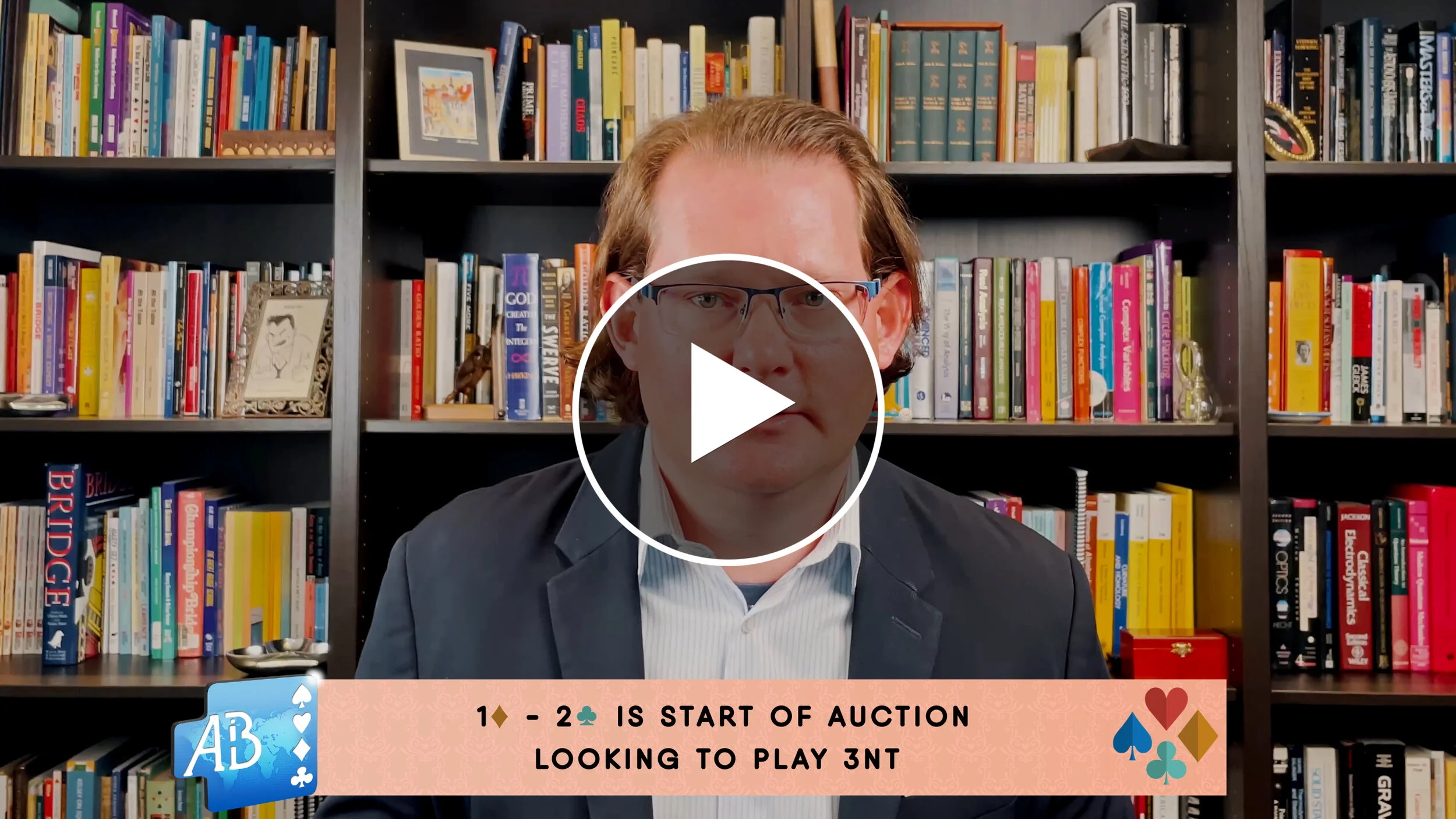

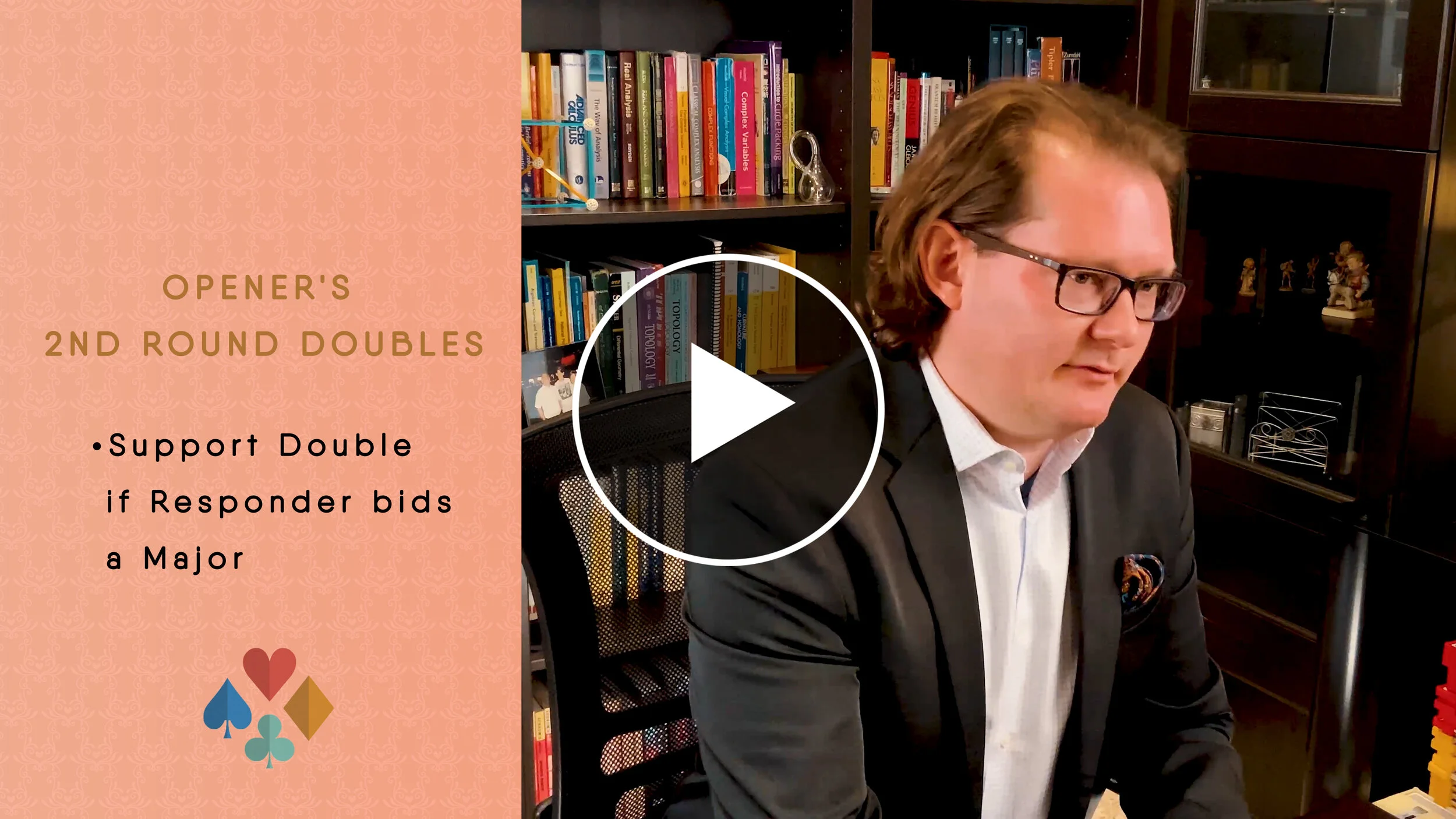

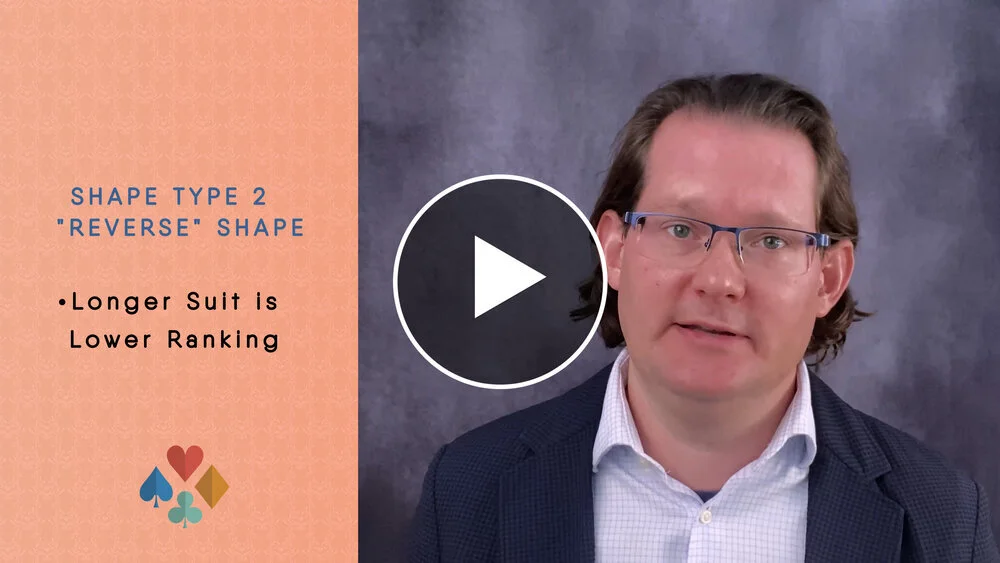




TWiB Lesson #338 (1 of 8)
Opener’s rebid is one of the most important actions in the auction. Here we look at how we make this bid when we have a balanced hand.
Lesson
Practice Hand
Video
Podcast