TWiB Lesson #359 (8 of 8)
This week we look at a variety of other doubles that are helpful in allowing us to compete in the bidding or better defend the hand.

TWiB Lesson #592 (8 of 9)
When partner opens the bidding 1-minor (1m), a jump shift to 2-Major (2M) by Responder can be used for a variety of different hand types. Both the standard approach of a strong jump shift and the common approach of a weak jump shift leave a lot to be desired. The modern style is for good hands to go slow, which makes a strong jump shift less appealing because it eats up valuable bidding space. With players responding to a 1m opening bid with 1M more and more aggressively, this makes using a weak jump shift less common…
TWiB Lesson #572 (6 of 9)
When responding to partner’s 1-Major opening bid, Responder tries to apply the Law of Total Tricks (LOTT) – getting to the size of the partnership’s fit as quickly as possible. This LOTT bidding is especially effective when our side has a 9+card fit. Bergen Raises are a set of conventional bids Responder can use when responding to a 1-Major opening bid with 4+card support (at least a 9+card fit). Let’s see how this system works.
TWiB Lesson #574 (8 of 9)
Jumping in the auction eats up a lot of bidding space, which is likely to make communicating with partner more difficult. Since our jump bid may make future communication more difficult, it should have a specific meaning. When partner opens the bidding, Responder’s jump shifts can be used to show a variety of different types of hands. We need to decide, as a partnership, which ones we want to use. We will choose different agreements for different situations.
TWiB Lesson #575 (9 of 9)
When partner makes a bid, and we choose to bid a suit of our own, this is called a freebid. In most normal situations freebids show values (called positive freebids) and are often forcing 1-round. We’ve all heard the saying -- a new suit is forcing by an unpassed hand. Unfortunately, this is not always true, but it is often our agreement. Let’s look at freebids made by a passed hand and see how the fact that we are passed changes these situations.
TWiB Lesson #577 (2 of 9)
When Opener makes a jump shift into a new suit with their second bid, it is a strong bid that creates a game forcing auction. This is a good bid because it ensures we reach game, but it is a bad bid because it eats up a lot of bidding space without fully describing our distribution. This is a problem. One of the most difficult opening hands to describe to partner is the unbalanced single-suited (one 6+card suit) hand with 18-19 HCP. This is one of the strongest hands that does not open the bidding 2♣. Let’s look at a system that helps us improve our jump shift methods.
TWiB Lesson #359 (8 of 8)
This week we look at a variety of other doubles that are helpful in allowing us to compete in the bidding or better defend the hand.
TWiB Lesson #328 (1 of 8)
Here we look at how our opening leads change when we are leading into a preemptive opening bid.
TWiB Lesson #337 (2 of 8)
This week we look at what our thinking is when we make an opening lead into a low level contract where the declarer has shown a minimum opening hand.
TWiB Lesson #346 (3 of 8)
Here we look at how to think about making an opening lead into a strong balanced (1NT) opening bid.
TWiB Lesson #347 (4 of 8)
When we are on lead against 3NT, then we need to know more than just “4th from our longest and strongest” to make a good opening lead.
TWiB Lesson #348 (5 of 8)
When the opponents bid to 4M there is often many bids to help us determine the best opening lead. Here we look at how to make use of this information .
TWiB Lesson #349 (6 of 8)
When our RHO is the declarer in 5-minor then there was often a long auction along the way. Leading against this contract is quick different than our traditional opening leads of 4th form your long and strongest. Let's see how.
TWiB Lesson #350 (7 of 8)
When the opponent’s bid slam, it is extremely important that we get off to the best opening lead. Here we look at how we make this decision..
TWiB Lesson #351 (8 of 8)
When the opponent’s are playing in a part-score then there are many options for what the best lead could be. We need to listen to the auction and try to figure out what is going on.
TWiB Lesson #338 (1 of 8)
Opener’s rebid is one of the most important actions in the auction. Here we look at how we make this bid when we have a balanced hand.
TWiB Lesson #339 (2 of 8)
Here we look at our rebid options as Opener when we hold a 1-suited hand.
TWiB Lesson #340 (3 of 8)
This week we look at how Opener uses their rebid to describe their unbalanced 2-suited hands.
TWiB Lesson #341 (4 of 8)
This week we look at how Opener uses their rebid to describe their unbalanced 2-suited hands.
TWiB Lesson #342 (5 of 8)
Here we look at Opener’s Rebids after Responder makes a positive freebid of a new suit.
TWiB Lesson #343 (6 of 8)
Here we look at how we make a rebid when partner makes a negative double and we are forced to take some action.
TWiB Lesson #344 (7 of 8)
Here we look at one of my favorite auction, when we open the bidding and RHO overcalls. Rebids get interest in this situation.
TWiB Lesson #345 (8 of 8)
Here we look at the uses of opener’s rebids after we have found a fit - in both constructive and competitive auctions.
TWiB Lesson #329 (1 of 8)
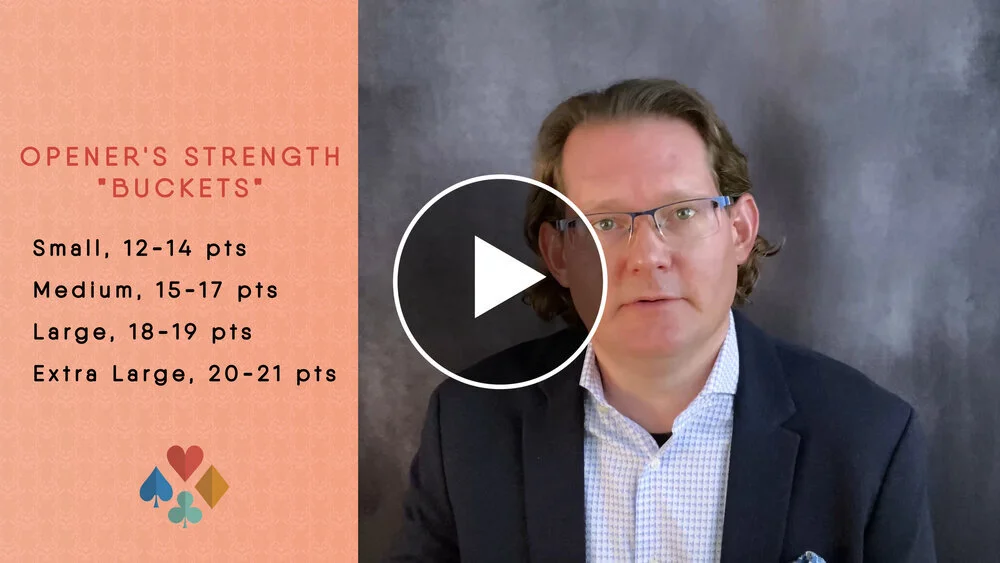
We look at modern methods of evaluating our hand before the auction begins.
TWIB Lesson #330 (2 of 8)
The week we look at how we re-evaluate our hand after partner opens the bidding.
TWIB Lesson #331 (3 of 8)
Here we continue our hand re-evaluation process by looking at how we make use of information about the opponents’ hands.