TWiB Lesson #374 (6 of 9)
When Responder uses 1NT Semi-Forcing then Opener must select their rebid to describe their hand. Make sure you know how to do that.

TWiB Lesson #592 (8 of 9)
When partner opens the bidding 1-minor (1m), a jump shift to 2-Major (2M) by Responder can be used for a variety of different hand types. Both the standard approach of a strong jump shift and the common approach of a weak jump shift leave a lot to be desired. The modern style is for good hands to go slow, which makes a strong jump shift less appealing because it eats up valuable bidding space. With players responding to a 1m opening bid with 1M more and more aggressively, this makes using a weak jump shift less common…
TWiB Lesson #572 (6 of 9)
When responding to partner’s 1-Major opening bid, Responder tries to apply the Law of Total Tricks (LOTT) – getting to the size of the partnership’s fit as quickly as possible. This LOTT bidding is especially effective when our side has a 9+card fit. Bergen Raises are a set of conventional bids Responder can use when responding to a 1-Major opening bid with 4+card support (at least a 9+card fit). Let’s see how this system works.
TWiB Lesson #574 (8 of 9)
Jumping in the auction eats up a lot of bidding space, which is likely to make communicating with partner more difficult. Since our jump bid may make future communication more difficult, it should have a specific meaning. When partner opens the bidding, Responder’s jump shifts can be used to show a variety of different types of hands. We need to decide, as a partnership, which ones we want to use. We will choose different agreements for different situations.
TWiB Lesson #575 (9 of 9)
When partner makes a bid, and we choose to bid a suit of our own, this is called a freebid. In most normal situations freebids show values (called positive freebids) and are often forcing 1-round. We’ve all heard the saying -- a new suit is forcing by an unpassed hand. Unfortunately, this is not always true, but it is often our agreement. Let’s look at freebids made by a passed hand and see how the fact that we are passed changes these situations.
TWiB Lesson #577 (2 of 9)
When Opener makes a jump shift into a new suit with their second bid, it is a strong bid that creates a game forcing auction. This is a good bid because it ensures we reach game, but it is a bad bid because it eats up a lot of bidding space without fully describing our distribution. This is a problem. One of the most difficult opening hands to describe to partner is the unbalanced single-suited (one 6+card suit) hand with 18-19 HCP. This is one of the strongest hands that does not open the bidding 2♣. Let’s look at a system that helps us improve our jump shift methods.
TWiB Lesson #374 (6 of 9)
When Responder uses 1NT Semi-Forcing then Opener must select their rebid to describe their hand. Make sure you know how to do that.
TWiB Lesson #375 (7 of 9)
When Responder starts with 1NT Semi-Forcing then they need to use their second bid to further describe their hand, in both shape and strength.
TWiB Lesson #376 (8 of 9)
When we have a hand that is almost strong enough to make a jump shift, but not quite, we make a 2nd bid that is non-forcing and then make a 3rd call to show our extra values. (Video Coming Soon)
TWiB Lesson #377 (9 of 9)
When we are in a 2/1 GF auctions then we have a variety of extremely useful slam bidding tools. Here we look at what these options are and how to best use them. (Video Coming Soon)
TWiB Lesson #360 (1 of 9)
This week we look at how we continue thee bidding with after Opener shows a balance hand by rebidding NT. This includes corrective bids, invitational ones, and game forcing ones.
TWiB Lesson #361 (2 of 9)
Here we look at how Responder continues the auction after Opener starts the bidding with 1-suit and rebids that same suit.
TWiB Lesson #362 (3 of 9)
Here we look at how the Responder continues the bidding when Opener shows a 2-suited hand.
TWiB Lesson #363 (4 of 9)
Here we look at how Responder continues the auction after Opener starts the bidding with 1-suit and rebids that same suit showing a strong hand - Reverse or Jump Shift. (Video Coming Soon)
TWiB Lesson #364 (5 of 9)
This week we look at how Responder continues the auction when they hear Opener make a support double. (Video Coming Soon)
TWiB Lesson #365 (6 of 9)
As Responder we can use a Negative Double with a variety of different hand shapes and strengths. Here we look at how we use our rebid to clarify to partner what type of negative double we made. (Video Coming Soon)
TWiB Lesson #366 (7 of 9)
After we make a freebid on the first round as Responder, our rebids on the second round of the bidding in these auctions are important. (Video Coming Soon)
TWiB Lesson #367 (8 of 9)
As Responder, your redouble shows 10+ points. Your follow-up bidding is important to fully describe your hand. (Video Coming Soon)
TWiB Lesson #368 (9 of 9)
After we respond with a suit, if LHO overcalls we need to have some good agreements about the meaning of our rebids. (Video Coming Soon)
TWiB Lesson #352 (1 of 8)
This week we look at the most fundamental of doubles: the Interferer’s takeout double.
TWiB Lesson #353 (2 of 8)
This week we look at one of the most important conventions in all of bridge, the negative double.
TWiB Lesson #354 (3 of 8)
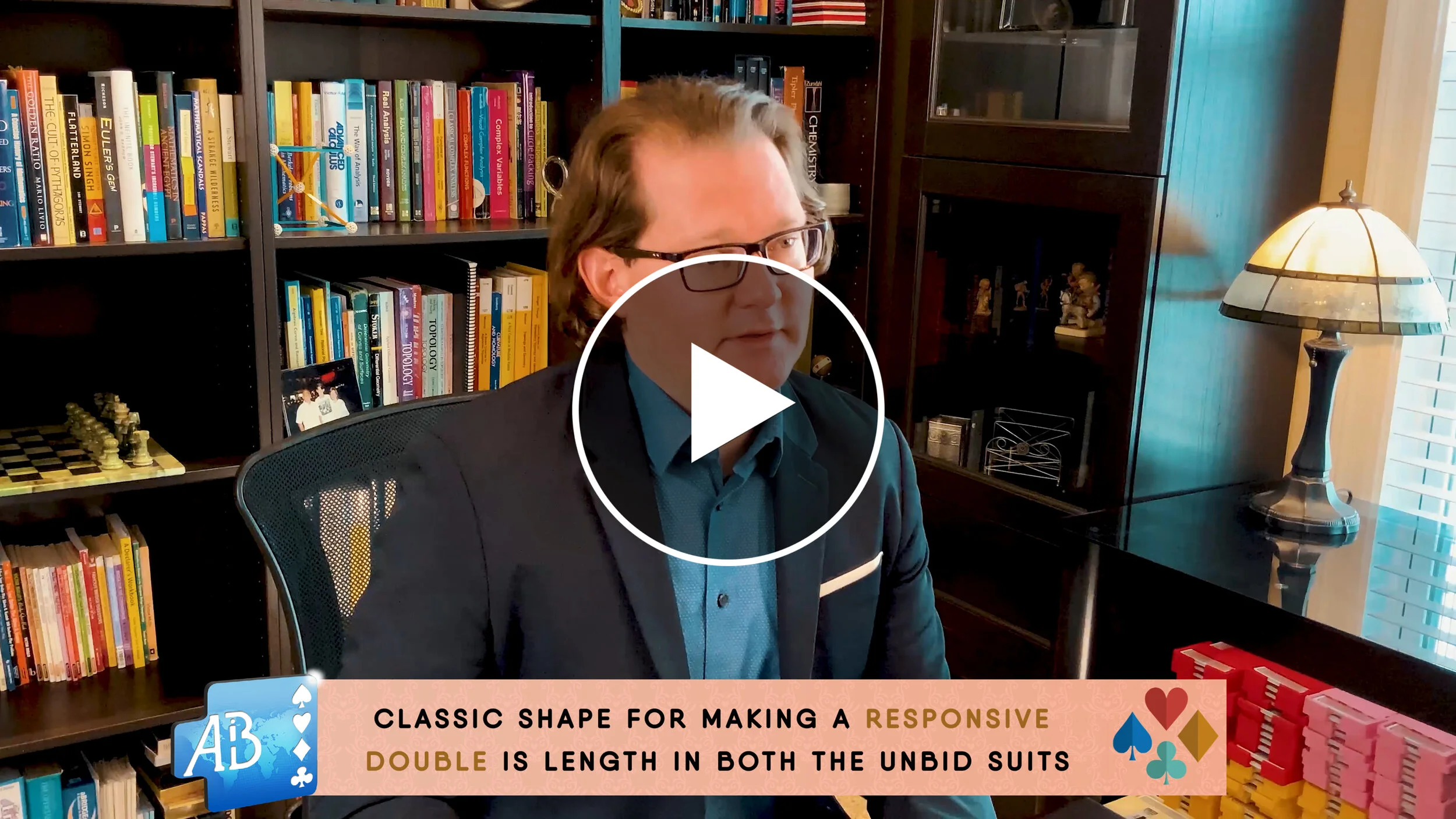
This week we move around the table to Advancer and look at their double for competing in the bidding - the responsive double.
TWiB Lesson #355 (4 of 8)
This week we move all the way around the table to the Opener and look at how they use a double - the support double.
TWiB Lesson #356 (5 of 8)
This week we look at when we are the last line of defense and how we choose to double to keep the auction alive — a reopening double.
TWiB Lesson #357 (6 of 8)
This week we look at doubles that are not takeout. These are not just penalty doubles, but the modern card-showing double and much more.
TWiB Lesson #358 (7 of 8)
This week we look at how we use the double card to compete in the bidding later in the auction.